

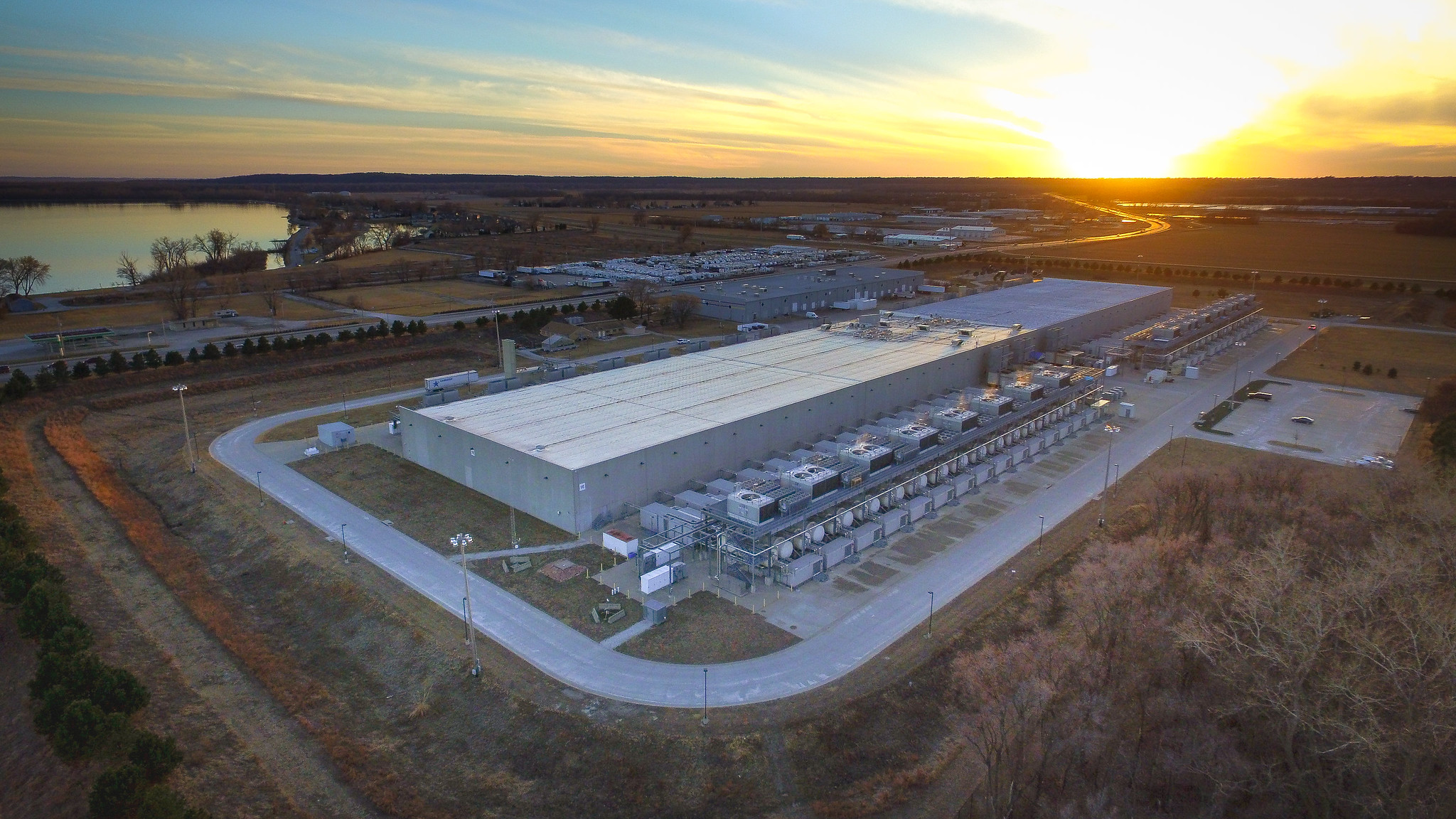


The data center boom is often described as inevitable. Artificial intelligence use is suddenly ubiquitous. Cloud computing is growing. Streaming, e-commerce, and digital services need somewhere to live. So, when a developer arrives with another massive, windowless facility (like the one in Iowa, pictured above), local officials are told to move quickly: approve the zoning, extend the infrastructure, grant the tax break, and be grateful the future chose their town.
That story leaves something important out.
Data centers may be part of the future, but they are not optional for Big Tech. The AI and cloud business models require more computing capacity near power, fiber, land, and major markets. Like Amazon warehouses when the company moved to rapid delivery, data centers are coming to many places fast — and that gives public officials far more bargaining power than developers want them to believe.
Localities should start acting like it.
City leaders should not have to negotiate in a “prisoners’ dilemma” created by nondisclosure agreements, consultant-driven urgency, and threats that the project will go elsewhere. But they rarely rewrite the rules alone. Outside pressure (a.k.a. “civic engagement”) is how transparency, job standards, and community benefits become deal terms.
Too often, economic development deals begin from the opposite assumption: that local governments must compete for Big Tech’s favor by offering secrecy, speed, and subsidies. A company quietly approaches officials. The project gets a code name. Residents are kept in the dark. By the time the public learns what is happening, the site has been selected, utilities lined up, zoning nearly settled, and tax abatements already moving.
At that point, the public’s leverage has been spent before the public knew it could have any.
Public officials need to stop treating Big Tech projects as prizes to be won and start treating them as transactions to be governed. Too much economic development policy chases famous corporate names with large subsidy packages, when the better strategy is investing in public goods that help many employers: schools, infrastructure, workforce training, small businesses, and local industry capacity.
The issue is not whether every data center should be opposed. Communities need digital infrastructure. Construction workers need work. Cities need property tax revenues. The question is whether some of the richest corporations in the world should get to use public assets on private terms.
The scale of Big Tech’s own spending makes the subsidy argument weaker. Just five companies — Alphabet/Google, Amazon, Meta/Facebook, Microsoft, and Oracle — have announced more than $710 billion in AI capital expenditures in 2026. Companies in that kind of buildout are not waiting for a county tax abatement to decide whether the AI economy needs servers. They need them. The public should negotiate from that fact.
Good Jobs First has long warned that data centers are not ordinary economic development projects. Hyperscale facilities can consume hundreds of acres, require enormous amounts of electricity and water, generate noise and air pollution, and receive large tax abatements. That scale of public burden should change the scale of public demands.
Start with the money. Tax abatements are not free. They are public spending through the tax code. When a city, county, or school district gives up revenue, that money is no longer available for classrooms, safety, libraries, parks, roads, housing, public health or basic services. When a state exempts data center equipment, building materials, or power purchases from sales taxes, local governments usually lose revenue too, and with no say.
Worse, in many places the public cannot even see the bill.
Good Jobs First reports that 14 states and scores of localities fail to disclose how much revenue they lose to data center tax abatements. In states that do report, losses are soaring: Georgia, Virginia, and Texas each lose $1 billion or more per year. That is not economic development strategy. It is spending without a budget.
The first reform is simple: Disclose the cost. Every state and locality that loses revenue of any kind to a data center tax abatement should report that loss in its Annual Comprehensive Financial Report.
The second reform is simpler: Stop subsidizing data centers.
Amazon, Microsoft, Facebook, Google, Apple, and other tech giants are not deciding whether they need data centers. They are racing to site them – in lots of places. Tax incentives are for industries that need help: These facilities are core infrastructure for companies worth trillions of dollars, not fragile start-ups or mature companies struggling to modernize. The best incentive policy is to repeal the tax breaks and require companies to pay their full freight.
That means full taxes. It also means fair energy prices and no utility tax abatements. Before communities even talk about “community benefits,” data center companies need to pay sales and property taxes and be placed in separate utility rate classes so households and small businesses are not forced to subsidize new power capacity built for hyperscale demand.
Good Jobs First made the same point about Amazon warehouses: When a corporation is coming because its business model requires it, governments should not pay it to arrive. They should turn the tables. Amazon needed warehouses near customers. Today, Big Tech needs data centers near land, energy, fiber, and markets. In both cases, the question is the same: why should taxpayers subsidize what the company already needs to do?
Public officials need to look at the world the way AI executives do, not the way site-selection consultants want them to. The companies know they must build. They know power, land, water, fiber and public approvals are increasingly scarce. With polls showing that 69 percent of Americans don’t want a data center near them, the companies also know they have fewer and fewer options. That is why communities should not give away leverage at the front door.
Process reforms come first. Communities cannot negotiate benefits for a project they are not allowed to understand. That means no nondisclosure agreements. No project code names. No mystery end users. No rushed votes before residents know how much electricity and water the project will use, how many polluting backup generators it will need, what subsidies are requested, what infrastructure upgrades are required, and what jobs will actually be created.
Then come the benefits — real ones, not corporate-washing. Community Benefits Agreements can be powerful tools. But they can also become a donation here, a STEM photo op there, a few charitable checks used to distract from a bad deal.
A real community benefit agreement cannot be a side letter attached to a subsidy giveaway. It must be enforceable, negotiated early, and tied to the actual costs of the project: infrastructure impact fees, energy and water protections, noise and pollution mitigation, public reporting and clawbacks if companies fail to deliver.
Then come job quality standards. Data centers can involve huge capital investments and major construction work, but they often create relatively few permanent jobs. That makes the construction phase the central employment impact of the project.
If public resources are involved, agreements should require project labor agreements, prevailing wages, local hiring, jobsite safety standards, and participation in state-certified apprenticeships. Permanent jobs should also carry job-quality standards: good wages, benefits, direct employment where possible, and first source hiring access for local residents.
This is not anti-growth. It is how communities build capacity for growth.
Data centers do not exist in a separate labor market. When they draw from the same pool of electricians, pipefitters, and other skilled workers without investing in training, they worsen skills shortages for everyone else. Responsible deals should grow the workforce, not simply consume it.
The AI economy is not inevitable in the form currently being offered. Communities don’t have to be roadkill. The question is not whether cities can afford to demand more from data centers. The question is whether they can afford not to.
Anthony Elmo is a public education funding defender with Good Jobs First, a national policy resource center that promotes corporate and government accountability in economic development. He also served as a field director for Obama for America. This article was published by Next City, a nonprofit news organization covering urban issues, earlier this month, and appears here with their permission.
Photo credit: Chad Davis
There's no previous post
Back to PublicationsThere's no next post
Back to Publications





























.jpg)






.jpg)














.jpg)













.jpg)







.jpg)








.jpg)










.jpg)