


In towns removed from New York City, there was a yearning to collectively grieve through steel that had once been part of the World Trade Center, to materialize a tragedy that had largely been televisual. Gordon Haberman did not need a piece of steel to make what happened at the World Trade Center feel real; he lost his daughter that day.
Haberman lives in Kewaskum, Wisconsin, a community of just over 4,000 people. His daughter Andrea, 25, was working in Chicago in 2001. She had a job in finance, had just bought a house, and gotten engaged. On September 11th, she was in New York on her first business trip. She had the great misfortune of being in the North Tower when it was hit. Mr. Haberman wanted to honor Andrea with a memorial in their village-like community, 50 miles north of Milwaukee, but he was not quite sure how.
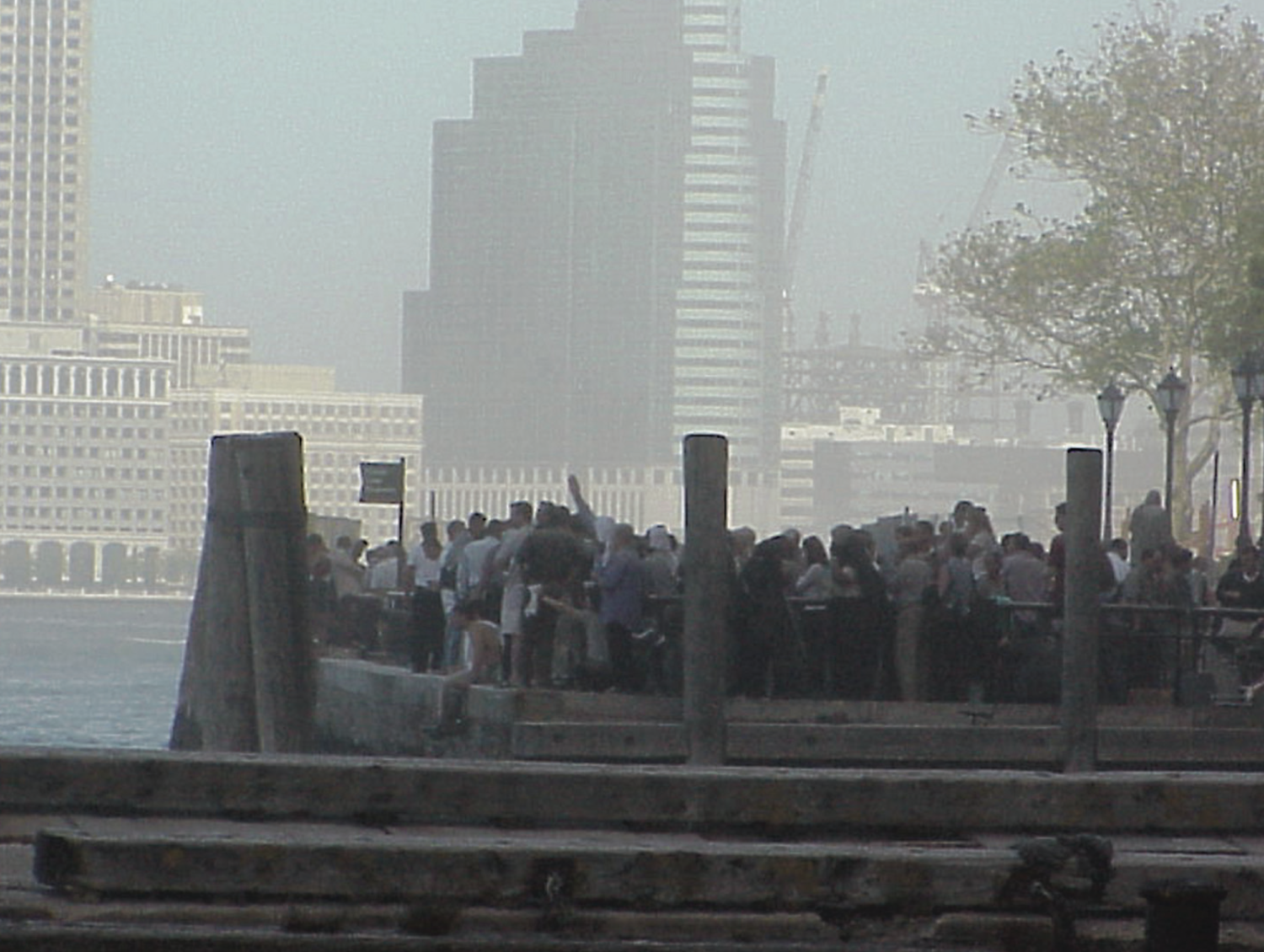
Haberman had travelled with his wife, Kathy, to New York in the spring of 2002, where they were met by officials from the Carr Futures Company (owned by the French bank Crédit Agricole), that Andrea was meeting with on the morning of 9/11. Like many of the large firms with offices in the towers, they had organized a weekend when survivors' families could fly in, meet at a hotel, and connect over their shared loss. Haberman walked downtown from the hotel to The Pile [pictured above, the informal name for the devastated WTC site], where recovery efforts were still underway. With his wife, he slipped through one police cordon and, at another, managed to convince an officer to turn a blind eye and ducked under a barrier of yellow tape.
They were able to make their way to a trailer where an ironworker passed them off to Charlie Vitchers [the site superintendent]. At first, Vitchers was incredulous: “How could they have made it through?” But then he was impressed with their determination. Improbably, Vitchers became their friend and contact person in the city.
The 9/11 steel program [systematizing a previously ad hoc process of releasing fragments of the Twin Towers for memorials] began in 2009. Haberman visited Hangar 17 at JFK airport [where Twin Towers salvage was stored] with representatives of what would become the 9/11 Memorial Museum. The group walked through the remnants of the towers, staring at mangled I-beams and the crushed steel lattice work from the façade. One Brooklyn welder who accompanied them, and who had been involved in Ground Zero cleanup efforts, pointed at a particular piece of metal. “That’s my cut,” he said.
Haberman, recollecting the moment over 20 years later noted, “These torch guys know how their torches cut, and can match the mark left on them when they cut that beam.” This seemed like a sort of presentiment for Haberman and he requested the piece identified by the Brooklyn welder to be shipped to Kewaskum.
Vitchers, who remained moved by their loss and inspired by the steel project, drove the steel artifact from his home in Pennsylvania to Wisconsin: a long trek made more difficult by having to secure insurance for the steel in every state that he passed through. When Haberman picked up the steel in Wisconsin it brought him a sense of being in a chain: a piece of metal had made its way from the towers to the hangar to a privileged position in the center of his community.
The memorial is just at the edge of the town’s small cluster of 19th century brick buildings. Three heavily manicured pathways lead into a circular plaza with tiered seating at the perimeter. The 2,500-pound steel beam is mounted at an angle in the plaza’s center. A large pentagonal base bears the words “NEVER FORGET.” Two ‘trellis towers’ stick up from a mass of flowers by the seating. They are Sweet Autumn Clematis, “chosen because it flowers in September” and to symbolize perseverance, “because of its ability to aggressively climb over anything.”
In a nod to Vitchers, the trellis is dedicated to the “volunteers who toiled at Ground Zero… to deconstruct the World Trade Center,” including many who “succumbed to cancers and other illnesses as a result of their exposure to cancers at the site.” Like other 9/11 memorials, the site has become a magnet for other tributes. A white marble statue, sculpted by Susan Falkman, was added in 2021. It resembles both flames and cathedral spires to “visually relate to the event and to transform the loss and horror to hope rising.”
Due in large part to Haberman’s personal connection to the events of 9/11, the Kewaskum Memorial became the Wisconsin 9/11 Memorial & Education Center, a frequent stop for groups of high school students, veterans, and service organizations like the Elks, Kiwanis, and Lions. While Andrea Haberman was not the only Wisconsinite killed in the attacks, few communities had the same connection to 9/11 that Kewaskum did.
Charlie Vitchers had driven the 2,200-pound beam to Wisconsin in 2012, but to open a memorial at the scale they wanted the town needed to gather almost $1 million in donations. The rotunda’s last element, the tiered steps, were only completed in 2021. The long gestation period allowed Haberman to work with the designer to add small elements, such as the podium next to the steel that sits on legs reminiscent of the tridents that were that calling card of Minoru Yamasaki’s Trade Center design.
Unlike many others, the Habermans eventually received confirmation of their daughter’s presence in the Towers. Her purse, buried below the service road the workers used to excavate the Ground Zero site, was recovered from the wreckage of the North Tower. It was one of the last sites where recovery workers were active in the spring of 2002. Amazingly, a few items were intact, such as her glasses, phone, and work badges (some are now in the collection of the 9/11 Memorial & Museum). Yet, Haberman still believes that the buildings’ distressed steel is the ultimate symbol of the tragedy. He is working to build a 9/11 education center next to the steel memorial so that emerging generations, with no lived experience of the attacks, can understand the history associated with the steel.
Samuel Holleran is a researcher, writer, and public artist. Max Holleran is a senior lecturer of social policy at the University of Melbourne. Their book, Scattered Steel: The Afterlife of the World Trade Center, is newly published by Three Hills, an imprint of Cornell University Press. This excerpt appears with the permission of the authors (they are brothers) and the publisher.
There's no previous post
Back to PublicationsThere's no next post
Back to Publications