



Urban Matters: Mohamed, you’ve recently produced a thought-provoking Center for New York City Affairs report about how the chasm between income earned from work and income from business activity and investment – the gulf between labor and capital – is widening nationwide, but especially in New York City. Give our readers a quick snapshot of your findings.
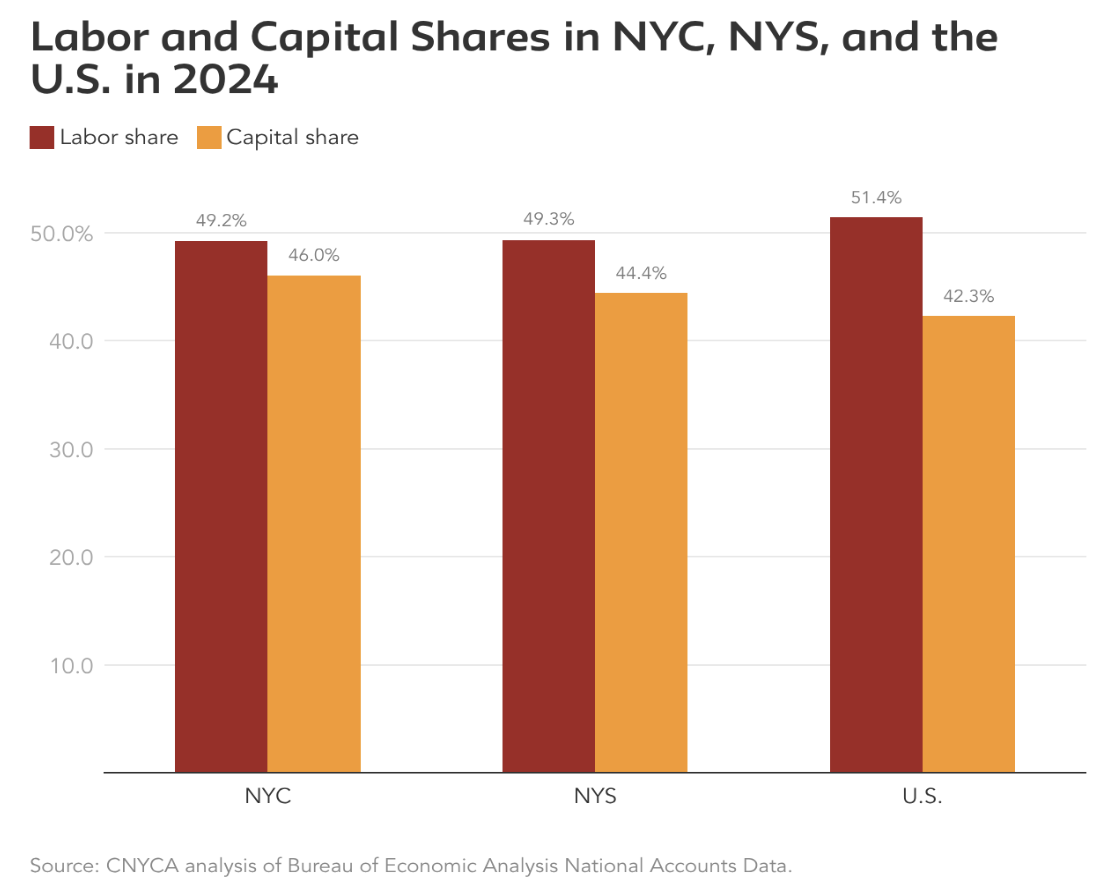
Mohamed Obaidy: They can be summarized in one sentence: New York City workers have become substantially more productive over the past quarter century, yet their share of the city’s income has significantly declined. It fell from roughly 56 percent in 2001 to 49 percent in 2024, while the share going to business and capital-related income rose from about 40 to 46 percent. New York City mirrors national and New York State trends, but the divide is now greater here. By 2024, the city had the lowest labor share and highest capital share of the three (see bar graph below).
This shift is also reflected in the growing gap between productivity and wages. Since 2001, hourly productivity increased by 36.3 percent, while real hourly wages for the bottom 90 percent of workers grew by only 22.5 percent.
James Parrott: You link this trend to declining unionization and labor bargaining power and, locally, how the austerity legacy of the 1970s fiscal crisis has been leveraged against workers. You argue that “fiscal discipline” has kept wages low for nonprofit and care workers providing important public services, which ties in with research by your colleagues at CNYCA. Could you say more about how City contracts and reimbursement rates (for child care workers, for example) create serious gender and racial pay inequities and have broader implications?
Obaidy: Globalization and declining unionization are indeed the usual suspects in the broad national drop in the labor share of income. But New York City presents a somewhat unique case. The fiscal crisis helped normalize austerity in a city known for its liberal leanings– and that’s important because government funding and actions should buffer downward pressure on wages across the labor market.
Take the cases you mention. Much of the discussion around human services and child care revolves around the demand side: we need affordable public services to reduce living costs and enable parents and low-income households to participate in the labor market. But there’s also the supply side: the pay and working conditions for the largely women of color workforces providing these services.
CNYCA has shown that nonprofit human services workers earn 25–30 percent less than comparable City agency employees, while home-based child care providers took home a median of about $6 an hour in 2023. Underfunded City contracts and inadequate reimbursement rates created these inequitable conditions. This has two consequences. It can put downward pressure on wage standards broadly and for women care workers in particular; it also risks undermining services that working families depend on. It effectively imposes a double penalty on lower-income New Yorkers, whether they provide these services or rely on them.
Parrott: Your report suggests local tax policy as a way to offset capital-labor inequality. Capital income flows mainly to the very wealthy, so is it better to focus on making the local personal income tax more progressive, or increasing the share of local taxes paid by businesses? And as to raising business taxes, how do you respond to the argument that capital is mobile and will flee New York?
Obaidy: Your question touches on a key tension in the report and in the debate around “taxing the rich.” As Thomas Piketty and others have shown, the higher you climb the income distribution, the greater the share of income derived from capital rather than wages.
So, it’s not an “either/or” choice. Our income tax is basically flat even though it should be off-setting some of the regressivity of the sales and property taxes. And looking at the City’s tax structure overall - including sales, property, and business taxes - the picture is more regressive, since some taxes place a greater burden on lower-income households. Business income taxation deserves greater attention, particularly on how the current tax code can better adjust to the modern organization of business income. Personal income taxes also remain important, and there is room to increase the personal income tax’s marginal rate at the very top of the income distribution, to offset capital-labor inequality.
As to capital mobility, I think the argument that businesses will simply flee New York is overstated. Cristobal Young has already shown that the millionaires who migrate away due to higher taxes remain a very small minority. As he points out, the cost of moving for wealthy individual is not determined by dollar figures alone. And business owners are profit-seekers. Their investment decisions depend on much more than tax rates. They seek a qualified workforce, well-developed infrastructure, public goods, and access to a significant consumer market. New York City has precisely these advantages, many financed by taxes, and not easily reproduced elsewhere.
Urban Matters: Taxes can be redistributive – but what about “pre-distributive” economic growth? Today, huge amounts of capital are going into pretty speculative AI investment. It could either go bust and risk leading to a recession – or succeed, and risk reducing employment generally. Are there ways, including locally, to instead encourage more sustainable, job-producing private investment?
Obaidy: This is actually the subject of a project I am currently working on with my colleague Lauren Melodia, on how to make New York City's economic growth more inclusive. So more to come on that.
Pre-distribution is about the kind of investment a city encourages and the kinds of jobs it creates. In New York, where finance plays such a central role, we cannot simply assume that high investment or productivity growth will translate into broadly shared gains. My recent work showed quite the opposite. The AI boom illustrates that tension. It may raise productivity, but it could also concentrate income or displace workers.
Locally, I see four priorities for better pre-distributive economic growth. First, direct public investment toward industries that generate additional private investment and jobs across the economy, what economists call multiplier effects. Second, identify where workers are in short supply and why: is it a lack of skills, or are low wages and poor working conditions driving people away? Third, improve working conditions by increasing the minimum wage to at least keep up with the increase of productivity and cost of living in the city. Fourth, adapt workforce development to future labor demand, particularly changes brought by AI and the transition to a more environmentally sustainable economy. Policymakers shouldn’t simply attract private investment, but also influence where investment goes and the type of employment it creates.